



































<< RETURN TO TACTICALPANTS.COM

Q&A with a Helicopter Cop

Helicopter Cop Darryl Kimball

Some police officers roam the streets on horseback. Others zip by on a Segway. And then there are the lucky few who patrol in the air.

For the last five years Darryl Kimball has done just that. Being a police pilot means doing a lot more than routine traffic stops.

He founded the website PoliceHelicopterPilot.com because there was a lack of knowledge about law enforcement aviation on the Internet. In fact, the top-ranking site on Google for “police helicopter pilot” gave sheriffs of the sky a bad rap. Nowadays his site is the No. 1 source for police and sheriff helicopter info.

This week Kimball announced on his blog that he has been promoted to sergeant and will be leaving the aviation unit for now.

“While there are no guarantees in life, I certainly hope and plan on returning to the air unit when the next sergeant position comes open, sometime in the not-too-distant future,” he writes. “But no worries, in the mean time my love for aviation, helicopters and law enforcement flying shall not be impeded, I assure you!”

Before the big news broke, Kimball sat down to answer some questions for us about law enforcement aviation.

How did you become involved with aviation?

Prior to being selected to my department’s aviation unit, I had no formal aviation experience. When I was a young deputy, my brother went out and got his fixed-wing private pilot license, and I flew with him quite a bit around Southern California and over to Vegas a couple of times. I loved flying but thought of it as too dangerous to really pursue.

As a deputy working the streets in San Diego County, I saw our aviation/helicopter unit in action many, many times over the years. I began to develop a strong interest in the unit and interviewed for a position for the first time in late 1999. At the time I had 15 years on my department as a deputy sheriff.

Five years and three interviews later, I was selected as a new “observer” or tactical flight officer in the unit. After about 18 months in the unit, I was sent to flight school by my department and returned as a commercially rated helicopter pilot.

How many police officers really get to fly helicopters?

Our department employs approximately 3,000 deputy sheriffs in detentions, courts and law enforcement field services. Our air unit is made up of approximately 14 deputy sheriff pilots. So you can see that overall, it is a small percentage of police officers or deputies who get the opportunity to work in the air unit and become pilots.

Do a lot of departments have aviation units or is that just in bigger metropolises?

The vast majority of small to medium size law enforcement agencies do not have an air unit and tend to rely on air support from the larger agencies in their region who do have air support units. This will often be a nearby large police department, sheriff’s department, the state police, highway patrol, etc.

There are, however, many smaller sheriff’s departments who operate one or two helicopters for specialized missions. These helicopters are often sourced for free from the military as surplus aircraft and supported through drug seizure money.

When are the helicopter units used? We really couldn’t imagine making a routine traffic stop in a helicopter…

Most agencies with formal air support units try to fly a certain number of hours per day in support of officers or deputies on the ground. Some agencies have more structured flight regimens while other agencies give the crews more discretion on when to fly. It is a combination of responding to radio calls and being on routine patrol so that you are close to the action when something starts to unfold.

Exactly what the helicopter is used for is often related to the geographic area where it is based. Police department helicopters generally speaking patrol within their city limits. Sheriff Department helicopters tend to get involved in rescue work and searches for missing hikers, etc. The San Diego Sheriff’s Dept. Air Support Unit does a considerable amount of work in San Diego’s vast east county which is home to both 6,000-foot mountain peaks and the Anza Borrego Desert State Park.

In addition to radio calls involving criminal activity, police and sheriff helicopter crews alike respond daily to missing children and missing elderly calls. In these types of situations, the P.A. system on the helicopter is often the most effective tool in finding a missing child or a missing Alzheimer’s patient for example.

An entire section of your website is devoted to “How to Become a Police Helicopter Pilot.” What advice would you give to someone interested in that career path?

The U.S. is full of experienced pilots that would love to fly for a law enforcement agency, but about 90 percent of all agencies with an air unit select their flight officers and pilots from the sworn members of their department.

There is no single reason for this, it is just how these air units developed over the past 50 years. Anyone wishing to become a law enforcement pilot should commit to becoming a sworn law enforcement officer and spending as much as 10 years working the streets and other assignments as they work their way to a position in the air unit. But they must do this knowing that there is no guarantee they will ever be selected. They will have to compete for these positions.
To be more specific, however, anyone who wishes to become a law enforcement pilot should research medium size to large agencies in their region who have an existing air unit with a long history. Our air unit has been in operation since the early 1970s. That means 30 years from now, it will in all likelihood still be in operation.

Now while you are working your way toward a position in the air unit, go out and get a fixed wing private pilot license. Do not waste your money on a helicopter license. Most agencies want you to have some aviation experience, but few expect you to get your own helicopter license (which is about twice as expensive as a fixed wing license.) Most agencies will train you to fly their helicopters.

So now you have a stable career as a law enforcement officer, you have your private airplane rating so you can go out and enjoy flying on your own time, and you are in the perfect position to be selected for a position in your department’s aviation unit.

What’s the most exciting part of the job?

The most exciting part of the job is still the chase. That is actively pursuing a fleeing suspect whether in a vehicle or on foot. We don’t want vehicle pursuits to occur, but we know they are still going to happen, and we want to be there to help out when they do.

The most challenging?

For the missions our unit performs, the most challenging for me is probably “slinging” or “long lining” marijuana in remote parts of the county. We do this many times throughout the marijuana growing season.

We are often working in mountains and canyons, battling the wind, while trying to get the empty hook on a 75-foot line to the narcotics officers on the ground in confined areas. Lifting the marijuana load out requires the pilot to monitor his power gauges in the helicopter while trying to read the wind and keep the helicopter out of dangerous flight conditions such as “loss of tail rotor effectiveness,” which can occur while pulling lots of power in certain downwind or crosswind conditions. This is probably the most dangerous mission our unit performs.

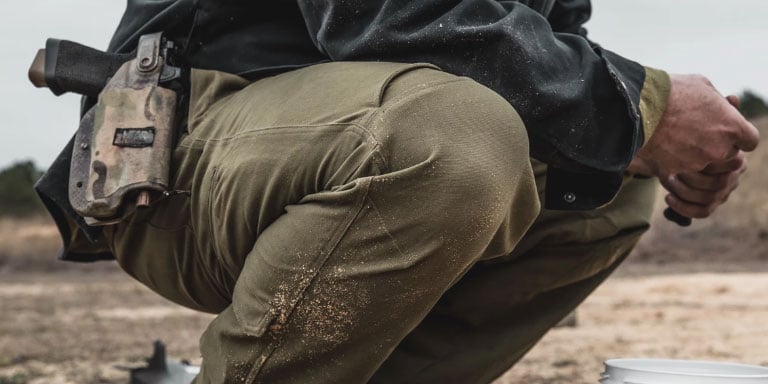
Do police helicopter pilots wear tactical pants?

We wear flame-resistant flight suits which certainly have tons of tactical pockets and cool places to put stuff.

Most of our members keep a couple sets of tactical clothing, pants, etc., for other assignments such as when teaching firearms at the academy or filling in on the SWAT team. A good pair of tactical pants is a must-have in our line of work.

(Image via Dan Megna)

Share and Enjoy:
  • Digg
  • del.icio.us
  • Facebook
  • Mixx
  • LinkedIn
  • StumbleUpon
  • Twitter
  • Yahoo! Buzz
  • email
  • Reddit
Posted on July 15, 2010 at 11:25 am by Jeanette K. · Permalink
In: Information

One Response

Subscribe to comments via RSS

  1. Written by andy thomsen
    on July 28, 2010 at 4:26 am
    Permalink

    What a job!, Great article

Subscribe to comments via RSS

Leave a Reply